Why Japanese sweets make good gifts
Compared with Western-style sweets, many wagashi (Japanese sweets) are only lightly sweet or tied to seasonal events, so they tend to be well received whatever the recipient's age or tastes. A classic item from a long-established shop also has the power to show, all on its own, that you chose with care.
On the other hand, sweets that don't keep long, such as namagashi (fresh, moist sweets), or ones that need to be cut can leave some recipients in an awkward spot. The most important thing when choosing a gift is to think about the recipient after they've received it.
Five things to check when choosing
| Criterion | What to check |
|---|---|
| Shelf life | Will it keep for a few days after you hand it over? The recipient may not be able to eat it right away |
| Individual wrapping | Is it easy to hand out at the office? Can it be shared without cutting or dividing? |
| Quantity | Does it contain a few more pieces than there are people in the recipient's department? |
| Portability | Is it fragile? Does it need to be kept cool in summer? |
| Story | Is there something you can mention as you hand it over, such as the shop's history or its signature item? |
For treats for an office, the basics are items that keep well and are individually wrapped. For thanks or congratulations to someone senior, something a little special works well, such as a classic item from a long-established shop or seasonal jo-namagashi (finely crafted fresh sweets).
Recommendations by occasion
| Occasion | Suitable sweets |
|---|---|
| Treats for your office or a client's | Individually wrapped monaka (wafer shells filled with bean paste), dorayaki (bean paste pancakes), baked sweets, small portions of yokan (sweet bean jelly) |
| Thanks to someone senior | Yokan from a long-established shop, seasonal jo-namagashi, an assortment of higashi (dry sweets) |
| Visiting to apologize | A calm, classic item that isn't too showy |
| Greetings (starting a new post or the New Year) | An assortment of long-lasting baked sweets or yokan |
| A small group | A small box of something a little luxurious, such as jo-namagashi |
When apologizing, it's safest to avoid bright wrapping or items meant to celebrate seasonal events, and to choose a calm classic instead.
Sweets that capture the season
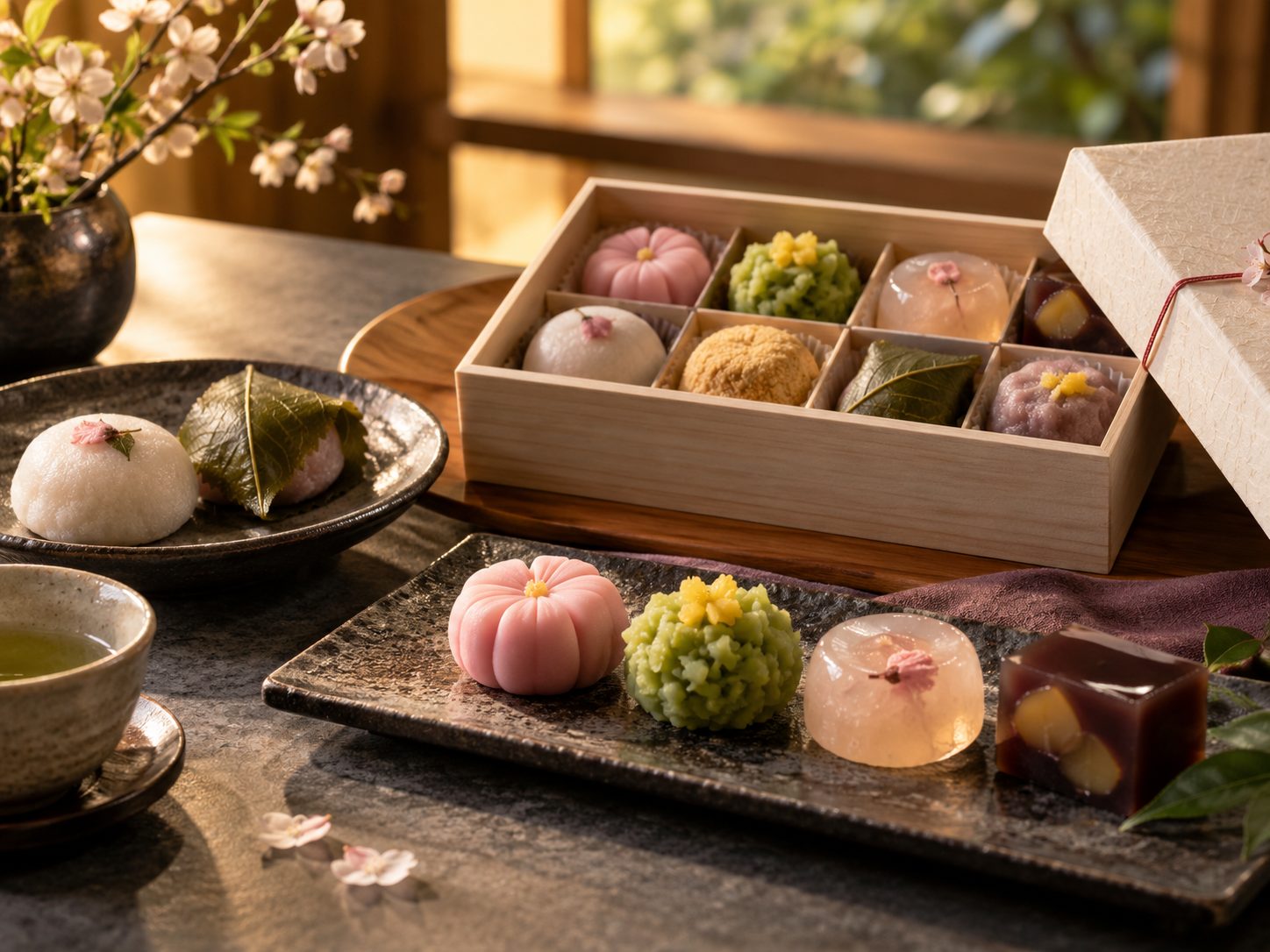
Part of the joy of wagashi is the way they reflect the changing seasons. Choosing a seasonal sweet gives you a ready-made conversation starter.
| Season | Typical sweets |
|---|---|
| Spring | Sakura mochi, kusa mochi (mugwort mochi), uguisu mochi, hanami dango (blossom-viewing dumplings) |
| Summer | Mizu yokan (soft bean jelly), kuzu manju (kudzu dumplings), warabi mochi, waka-ayu (sweetfish-shaped cakes) |
| Autumn | Kuri kinton (chestnut sweets), tsukimi dango (moon-viewing dumplings), kuri mushi yokan (steamed chestnut yokan), ohagi |
| Winter | Tsubaki mochi, hanabira mochi (for the New Year), sweets shaped like the year's zodiac animal |
Seasonal namagashi feel special because they are only available at that time of year. Many don't keep long, though, so think about whether the recipient will be able to eat them the same day.
Budget and noshi guidelines
The usual budget for a business gift is around ¥3,000 to ¥5,000. Something too expensive can actually make the recipient feel uncomfortable. For an apology or special thanks, people sometimes go for a slightly higher price range.
Whether to add noshi (formal gift paper with a written inscription) depends on the occasion.
- Thanks: The inscription reads "御礼" (With thanks), with a red-and-white mizuhiki cord tied in a bow.
- Greetings: The inscription reads "御挨拶" (Greetings). Used for visits such as starting a new post or the New Year.
- Apologies: The usual practice is to skip the noshi and use plain wrapping paper.
- Casual treats: No noshi is needed.
Tell the shop it's a gift for a visit, and they can help you choose wrapping that suits the occasion.
Etiquette for handing it over
- Don't buy it near your destination: Prepare it in advance, so it doesn't look as if you grabbed something nearby in a hurry.
- Take it out of the paper bag: The bag is only for carrying it. Take the item out and hand it over with both hands, turned so the front faces the recipient.
- Timing: As a rule, hand it over once you've been shown into the room and have exchanged greetings.
- Add a few words: Briefly say why you chose it, with something like "Please enjoy this with everyone" or "I picked something seasonal."
It used to be standard to say "It's nothing much, but…" These days, more people offer something more positive, such as "Just a small token" or "I hope you like it." Take the paper bag back with you unless the recipient asks for it.
Summary
- Check the shelf life, individual wrapping, quantity and how easy it is to carry.
- For office treats, choose something easy to share. For someone senior, something special. For an apology, a calm classic.
- Seasonal sweets make good conversation starters, but watch the shelf life.
- Budget around ¥3,000 to ¥5,000.
- Take it out of the paper bag, and hand it over with a few words on why you chose it.
Featured shops
We'll add the shops to this article as soon as we're ready to cover them.